2021-2022: Combustion Chamber Lead
Role: Combustion Chamber Lead
This year marked the transition from nozzle-centric work to full propulsion subsystem ownership. The focus shifted to integrating injector, chamber, liner, feed instrumentation, and hot-fire validation into a single engineering loop.
Propulsion Subsystem Integration
Integrated nozzle, liner, injector, and chamber architecture as one validated system.
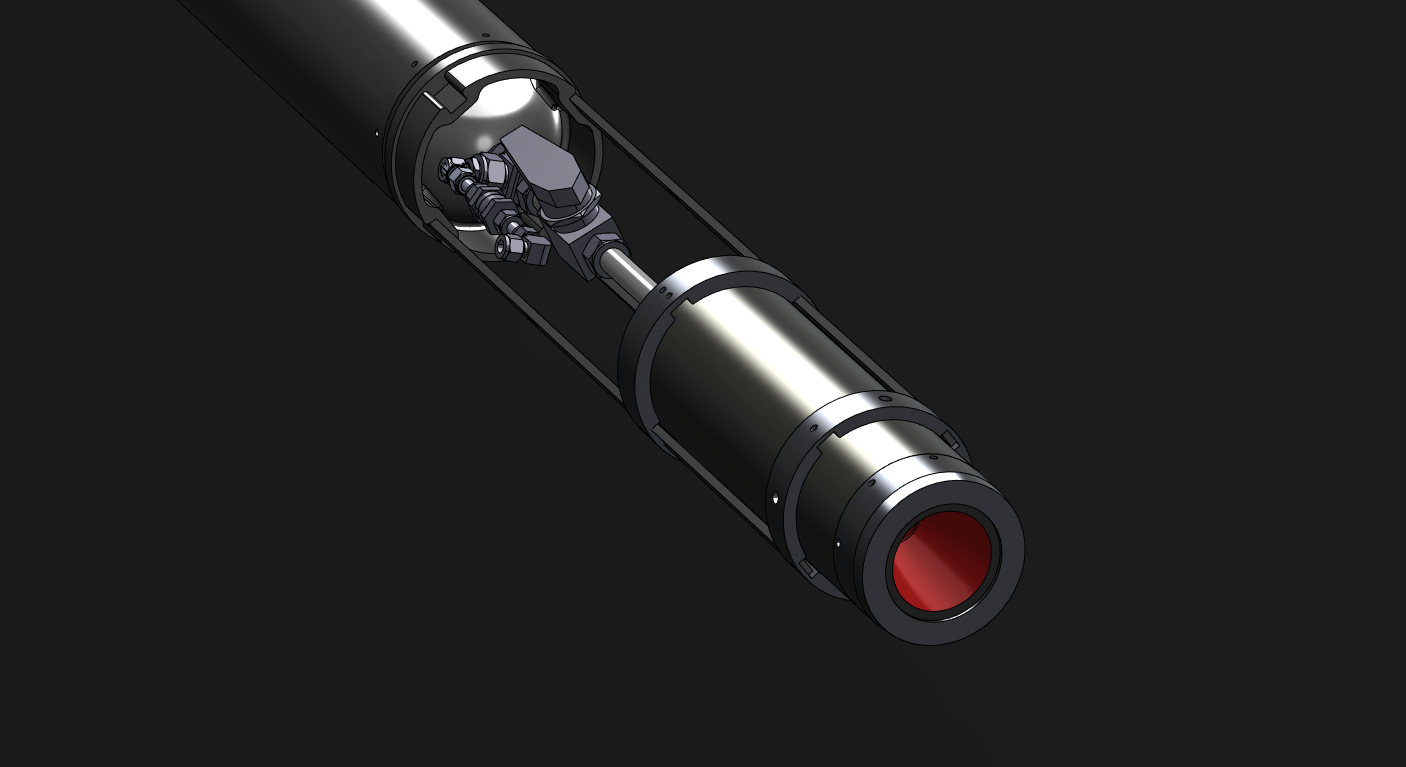
I led integration of the graphite nozzle stack with chamber interfaces and insulation strategy, while driving injector iteration against oxidizer mass-flow targets. Work emphasized interface robustness, manufacturability, and thermal survivability under expected burn conditions.
I led integration of the graphite nozzle stack with chamber interfaces and insulation strategy, while driving injector iteration against oxidizer mass-flow targets. Work emphasized interface robustness, manufacturability, and thermal survivability under expected burn conditions.
Instrumentation and Test Infrastructure
Built high-pressure data pathways to make hot-fire results decision-grade.
I helped define and validate high-pressure feed and instrumentation architecture, including thrust-stand signal quality, load cell calibration workflow, and repeatable DAQ handling. The objective was to convert static fires into quantifiable design feedback instead of one-off demos.
I helped define and validate high-pressure feed and instrumentation architecture, including thrust-stand signal quality, load cell calibration workflow, and repeatable DAQ handling. The objective was to convert static fires into quantifiable design feedback instead of one-off demos.
Static Fire Correlation
Closed the loop between simulation predictions and measured thrust behavior.
Static-fire campaigns were used to compare predicted performance against recorded thrust and pressure behavior. This validation step surfaced model biases, improved confidence bounds, and guided follow-on design decisions for flight-intent hardware.
Static-fire campaigns were used to compare predicted performance against recorded thrust and pressure behavior. This validation step surfaced model biases, improved confidence bounds, and guided follow-on design decisions for flight-intent hardware.
Thermal and Structural Validation
Treated thermal and structural margins as mission constraints, not afterthoughts.
Transient thermal and structural checks were incorporated into design iteration so combustion and load environments were evaluated before hardware lock-in. That discipline enabled propulsion decisions to be made within system-level safety and reliability boundaries.
Transient thermal and structural checks were incorporated into design iteration so combustion and load environments were evaluated before hardware lock-in. That discipline enabled propulsion decisions to be made within system-level safety and reliability boundaries.