2020-2021: Computational Redesign
Role: Nozzle Redesign Lead
During the remote year, the propulsion effort became primarily computational: iterate geometry, benchmark performance, and validate every improvement against flow diagnostics. This period turned CFD from a visualization tool into a decision tool.
Baseline Failure Mode Characterization
Isolated shock and separation behavior in GEN 1 as the dominant efficiency limiter.
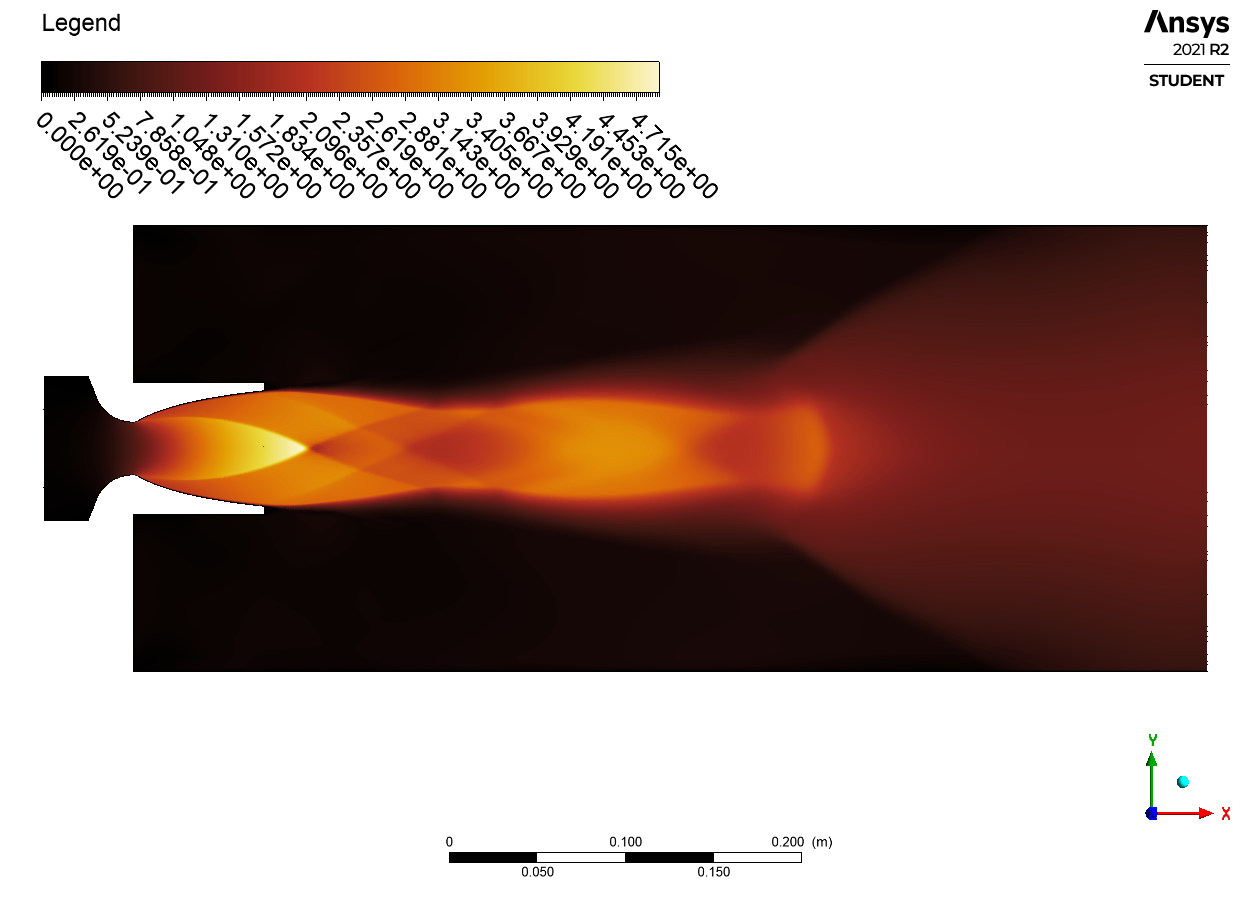
I benchmarked the baseline contour and identified where expansion quality degraded near the throat and early diverging segment. Rather than treating this as a generic underperformance result, the analysis tied loss mechanisms to local contour behavior that could be redesigned.
I benchmarked the baseline contour and identified where expansion quality degraded near the throat and early diverging segment. Rather than treating this as a generic underperformance result, the analysis tied loss mechanisms to local contour behavior that could be redesigned.
GEN 2 Geometry Iteration
Refined expanding parabolic contour to shift shock downstream and stabilize expansion.
The redesign targeted smoother pressure-gradient evolution through the diverging section. By adjusting contour curvature and throat-adjacent geometry, the updated profile reduced early adverse behavior and improved plume development.
The redesign targeted smoother pressure-gradient evolution through the diverging section. By adjusting contour curvature and throat-adjacent geometry, the updated profile reduced early adverse behavior and improved plume development.
Quantified Performance Gains
Demonstrated measurable gains without changing chamber pressure class.
GEN 2 benchmarking produced clear improvements over GEN 1: specific impulse increased by about 3.3%, thrust increased by about 3.56%, and pressure-ratio recovery improved by about 25%. The significance was not just the gains, but that they were traceable to geometry changes and repeatable simulation conditions.
GEN 2 benchmarking produced clear improvements over GEN 1: specific impulse increased by about 3.3%, thrust increased by about 3.56%, and pressure-ratio recovery improved by about 25%. The significance was not just the gains, but that they were traceable to geometry changes and repeatable simulation conditions.
Decision-Quality Benchmarking Pipeline
Converted qualitative contour discussions into quantitative design decisions.
I structured side-by-side GEN 1 vs GEN 2 comparisons using consistent Mach and pressure visualizations, allowing the team to choose designs from evidence rather than preference. This year set the program's modeling standard for later subsystem integration work.
I structured side-by-side GEN 1 vs GEN 2 comparisons using consistent Mach and pressure visualizations, allowing the team to choose designs from evidence rather than preference. This year set the program's modeling standard for later subsystem integration work.