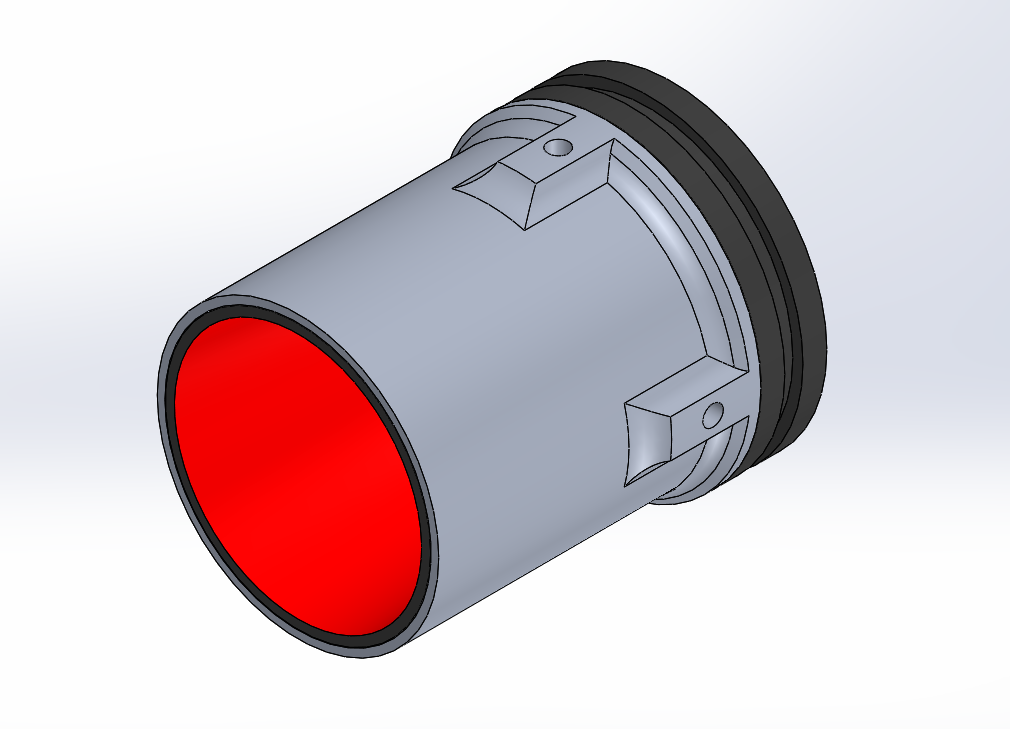
2019-2020: First Nozzle Architecture
Role: Propulsion Member (Nozzle Focus)
This year established the analytical foundation of the propulsion program. The focus was converting compressible-flow theory into a manufacturable nozzle architecture and learning where ideal assumptions failed in real geometry.
First Nozzle Architecture and Performance Target
Designed GEN 1 pressure-optimized nozzle at Ae/At about 4.8-5.1.
The first-generation graphite nozzle was sized for hybrid motor operating conditions and ambient launch assumptions. I translated isentropic design constraints into CAD-ready geometry and built the baseline contour around practical manufacturing limits, not just ideal equations.
The first-generation graphite nozzle was sized for hybrid motor operating conditions and ambient launch assumptions. I translated isentropic design constraints into CAD-ready geometry and built the baseline contour around practical manufacturing limits, not just ideal equations.
Early CFD Findings and Shock Behavior
CFD revealed early non-ideal flow behavior near the throat.
Initial CFD runs showed flow features that deviated from clean isentropic expansion, including indications of early shock behavior and pressure decay near the throat-expansion transition. That finding reframed the work from "designing a nozzle" to diagnosing the mechanisms behind thrust loss.
Initial CFD runs showed flow features that deviated from clean isentropic expansion, including indications of early shock behavior and pressure decay near the throat-expansion transition. That finding reframed the work from "designing a nozzle" to diagnosing the mechanisms behind thrust loss.
Structural and Thermal Feasibility
Began coupled FEA validation of pressure and thermal limits.
I performed first-pass structural and thermal checks to bound stress, deformation, and heat load under expected firing conditions. This step identified where geometry was mechanically viable but still aerodynamically improvable, preventing overconfidence from purely analytical results.
I performed first-pass structural and thermal checks to bound stress, deformation, and heat load under expected firing conditions. This step identified where geometry was mechanically viable but still aerodynamically improvable, preventing overconfidence from purely analytical results.
From Model to Hardware
Machined GEN 1 nozzle hardware and modular aluminum support.
The year closed with physical fabrication of GEN 1 hardware, including graphite nozzle components and an aluminum modular support interface. Building and machining the design exposed tolerance, assembly, and integration constraints that are easy to miss in simulation-only workflows.
The year closed with physical fabrication of GEN 1 hardware, including graphite nozzle components and an aluminum modular support interface. Building and machining the design exposed tolerance, assembly, and integration constraints that are easy to miss in simulation-only workflows.