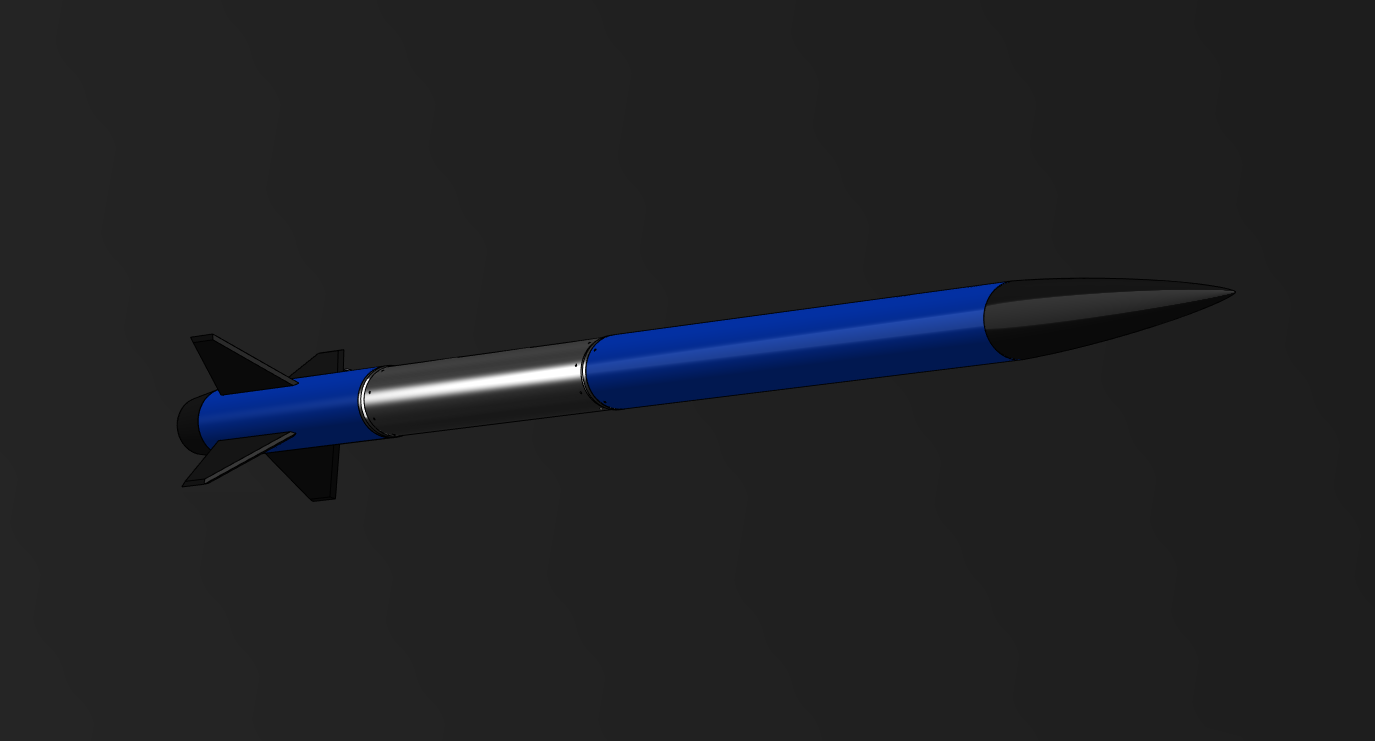
Columbia Space Initiative Hybrid Rocket Program
Project Narrative
This project tracks my technical growth from first-principles nozzle analysis to full program leadership of Columbia's first 6-inch hybrid rocket flight. Across four academic years, the work evolved from isolated propulsion geometry to integrated systems execution: nozzle design, combustion architecture, static-fire validation, and finally launch operations at Spaceport America Cup.
The through-line was consistent: identify the dominant failure mode, quantify it, redesign around it, and close the loop in hardware. Early work focused on shock behavior near the throat and expansion contour limits. Mid-program work shifted into injector, chamber, instrumentation, and hot-fire correlation. Senior-year work expanded into team-level systems engineering, structural redesign, and flight readiness for a 50+ member organization.
Freshman Year (2019-2020): Foundations in Hybrid Propulsion
Moved from textbook compressible flow to implemented nozzle hardware.
As a propulsion member focused on nozzle development, I designed the first pressure-optimized graphite nozzle architecture (Ae/At about 4.8-5.1) and translated compressible-flow theory into manufacturable geometry. CFD exposed early shock behavior near the throat, and FEA established first-pass structural and thermal margins. I also machined GEN 1 nozzle hardware and an aluminum modular support, turning analysis into real components.
As a propulsion member focused on nozzle development, I designed the first pressure-optimized graphite nozzle architecture (Ae/At about 4.8-5.1) and translated compressible-flow theory into manufacturable geometry. CFD exposed early shock behavior near the throat, and FEA established first-pass structural and thermal margins. I also machined GEN 1 nozzle hardware and an aluminum modular support, turning analysis into real components.
Sophomore Year (2020-2021, Remote): Computational Redesign
Turned a qualitative flow-separation issue into quantified performance gains.
During the remote year, the propulsion workflow became CFD-driven and iteration-heavy. I redesigned the expanding parabolic contour (GEN 2), pushed shock formation farther downstream, and benchmarked GEN 1 vs GEN 2 with Mach contours and thrust metrics. The redesign produced measurable improvements: +3.3% specific impulse, +3.56% thrust, and +25% pressure-ratio recovery.
During the remote year, the propulsion workflow became CFD-driven and iteration-heavy. I redesigned the expanding parabolic contour (GEN 2), pushed shock formation farther downstream, and benchmarked GEN 1 vs GEN 2 with Mach contours and thrust metrics. The redesign produced measurable improvements: +3.3% specific impulse, +3.56% thrust, and +25% pressure-ratio recovery.
Junior Year (2021-2022): Combustion Chamber Lead
Shifted from component modeling to subsystem validation through hot-fire data.
As Combustion Chamber Lead, I integrated nozzle, liner, injector, feed instrumentation, and test operations into one propulsion subsystem. Work included oxidizer mass-flow modeling, transient thermal and structural validation, and thrust-stand data processing with calibrated load-cell pipelines. Static-fire campaigns were used to correlate simulation outputs against measured thrust behavior.
As Combustion Chamber Lead, I integrated nozzle, liner, injector, feed instrumentation, and test operations into one propulsion subsystem. Work included oxidizer mass-flow modeling, transient thermal and structural validation, and thrust-stand data processing with calibrated load-cell pipelines. Static-fire campaigns were used to correlate simulation outputs against measured thrust behavior.
Senior Year (2022-2023): Team Lead and First 6-Inch Flight
Moved from subsystem authority to full program integration and launch execution.
As Rocket Project Lead, I directed a 50+ member team and led the structural transition from a 4.5-inch architecture to a modular 6-inch vehicle. The program integrated propulsion, structures, avionics, and recovery under flight timelines, including valve-system transition and static-fire readiness campaigns. The effort culminated in the team's first 6-inch hybrid rocket flight at Spaceport America Cup.
As Rocket Project Lead, I directed a 50+ member team and led the structural transition from a 4.5-inch architecture to a modular 6-inch vehicle. The program integrated propulsion, structures, avionics, and recovery under flight timelines, including valve-system transition and static-fire readiness campaigns. The effort culminated in the team's first 6-inch hybrid rocket flight at Spaceport America Cup.